
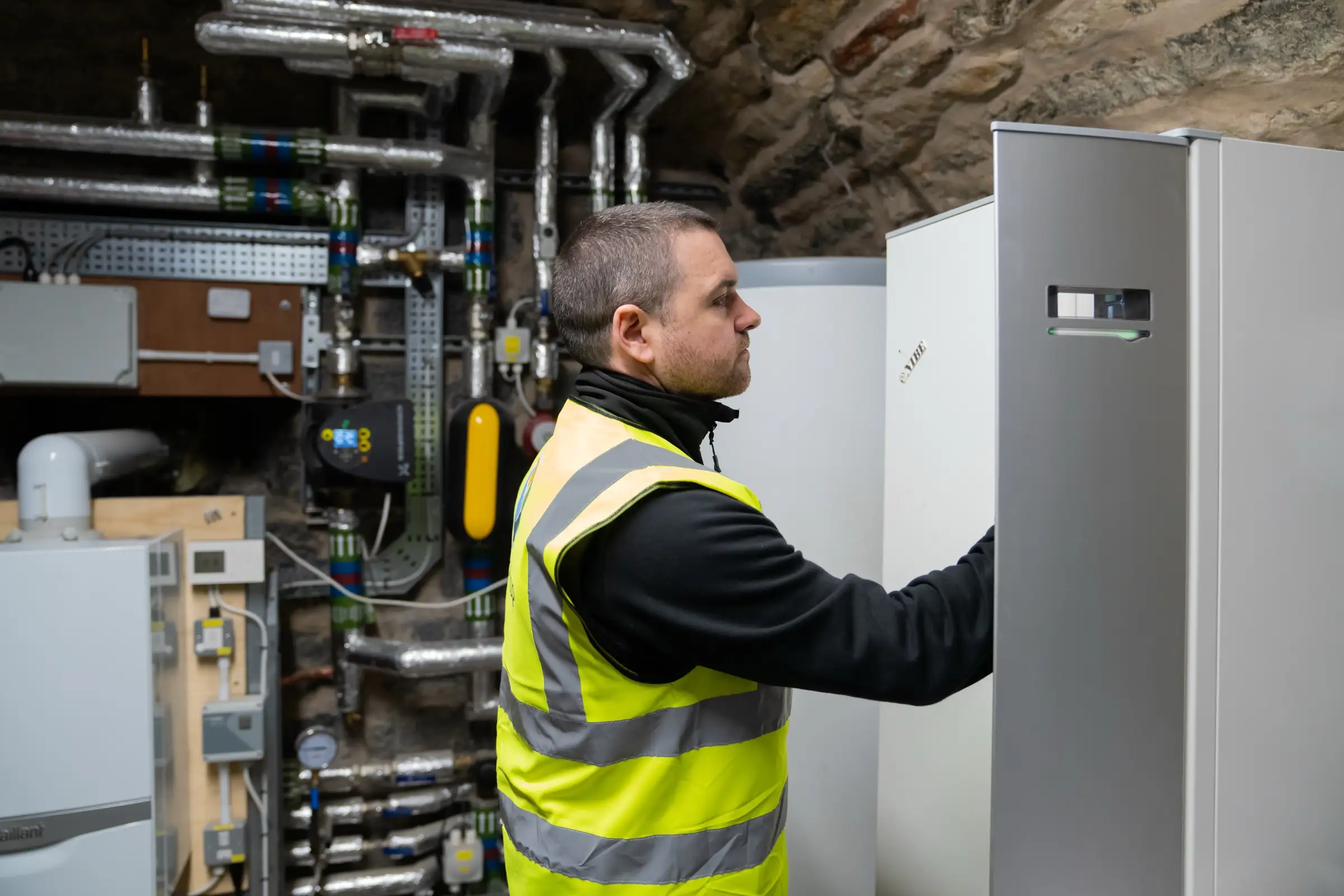
Case study · Ground source heat pump · gas hot-water assist · UFH + column radiators
Rossend Castle: a NIBE ground source heat pump in a historic Fife building.
A commercial-to-residential conversion of Rossend Castle on the Burntisland shore. The project started during Covid lockdowns and ran through to completion as the building moved out of its previous non-domestic uses and into a permanent home for its new owners — with a NIBE ground source heat pump as the heart of the heating system.
- Location
- Rossend Castle, Burntisland, Fife
- System
- NIBE ground source heat pump · gas boiler (hot water demand) · borehole array
- Heat distribution
- Underfloor heating across all floors + mix of radiators including column rads
- Started
- Covid lockdowns
The starting point
A historic Fife castle becoming a home again.
Rossend Castle stands on the Burntisland shore, with centuries of history behind it and a long list of past uses including a recent stint in non-domestic (office and similar) use. By the time we became involved, the new owners were converting it back into a residence and wanted a heating system that would do justice to the building's scale and fabric without compromising on running cost.
Their brief was clear: ground source heat pump. The site had the land for a borehole array, the heat demand to justify the borehole investment, and an owner willing to specify quality kit and take a long view on payback. The project started during Covid lockdowns, which made phasing and access a planning exercise in its own right.
What we installed
Borehole array, NIBE GSHP, gas hot-water assist, underfloor across every floor.
NIBE ground source heat pump as the primary heat source, sized to the building's substantial heat load. Ground source was the right answer here for both reasons it usually is: the property had the land available for a borehole array, and the building's heat demand was at the scale where the GSHP's running-cost advantage over air source genuinely pays back the higher upfront cost over the system life.
Borehole drilling arranged through a specialist drilling partner under our project management. We co-ordinated the rig access, the array specification, and the connections back to the plant room.
Gas boiler assisting hot water demand — on a building this size with peak hot-water draws, a small gas boiler handles the top-end of the hot-water curve while the ground source heat pump handles base load and space heating year-round. We arranged the gas line as part of the works.
Underfloor heating on all floors, paired with a mix of radiators including period-appropriate column radiators where surface area or aesthetics called for them. Heat distribution in a building like this isn't a one-spec answer — it's room by room, and that's how we designed it.
We carried out all the heating works in-house.
The outcome
A castle that's comfortable to live in, year-round.
The building works as a year-round home again: the ground source heat pump carries space heating and hot-water base load across every floor, the gas assist covers the peaks a building this size can throw at the hot-water system, and the room-by-room mix of underfloor and radiators keeps a large, historic fabric comfortable rather than fighting it.
The strongest reference an install can get is a customer who comes back: the owners have returned to us for further work since. For a project of this scale and sensitivity — a historic building, a borehole array, a phased job that began under lockdown — a repeat relationship is the outcome we're proudest of.
The service
Considering ground source for a large or historic property?
Ground source is the right answer for a specific set of properties — including listed and conservation-area buildings, large country homes, and any site where an outdoor air source unit isn't acceptable. Compare with air source honestly first.
Get in touch
Tell us about your project.
We'll be in touch within one working day. No call-out fee, no obligation.
Thanks
We'll be in touch within one working day.
If it's urgent, call us on 01463 231 423 — Monday–Friday, 08:00–17:00.
Prefer to talk? Call 01463 231 423 or email info@mcinnesgroup.co.uk.