
Battery storage
Power, on your terms.
A home battery stores electricity — from your solar panels in summer, or from off-peak grid windows in winter — and discharges it when you need it most, cutting your bills and your dependence on the grid at peak times.
Two minutes, no obligation — indicative pricing for solar & battery.
How it works
Charge when it's cheap. Discharge when it's not.
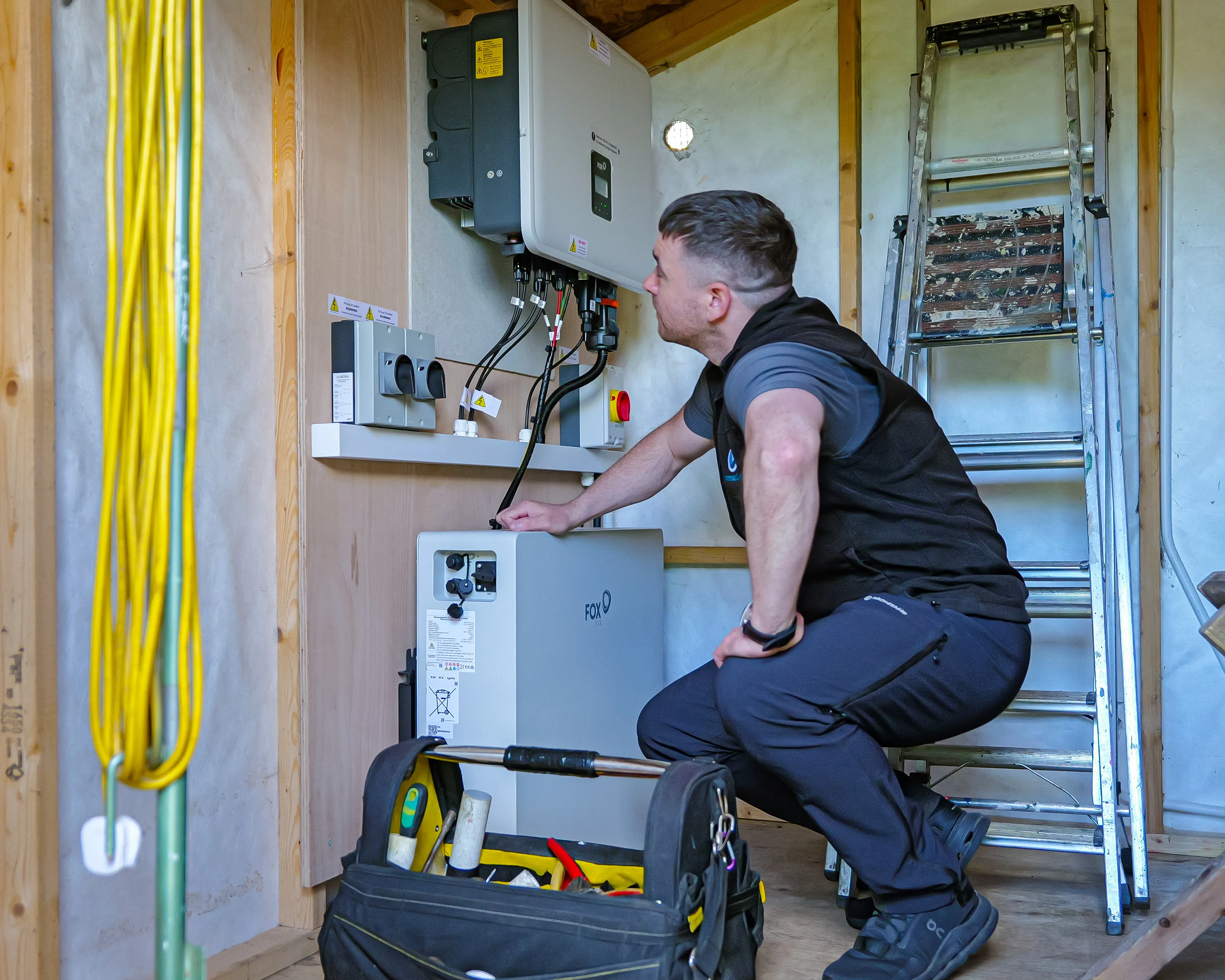
A lithium-ion battery (typically 5–15 kWh usable capacity) sits indoors — most often a utility room or garage — and connects to your home's consumer unit. It charges either from your solar panels when they are generating surplus, or from the grid during cheap-rate overnight windows like those offered by Octopus Go or Intelligent Octopus.
When demand rises — kettle, oven, heat pump, EV charger — the battery discharges first, displacing expensive peak-rate electricity. The whole system is controlled by a smart inverter that knows your tariff and learns your patterns.
How we work
Six steps from estimate to a tuned system.
Battery installs run through the same six-stage process as every job we do — with a usage profile and smart-tariff plan at the pre-start survey, and remote monitoring tuning the system through its first year of overnight charging.
-
Step 1
Free estimate
A no-obligation estimate based on what you tell us about the property and what you want the system to do. No call-out fee, no pressure.
-
Step 2
Pre-start survey
Once an estimate is accepted, we carry out a proper site survey before any installation — measuring the building, modelling heat loss or generation, and checking the existing services.
-
Step 3
Full proposal
Issued after the survey. Clearly flags any changes from the estimate, with the reasoning. Fully transparent up front — no mid-job surprises.
-
Step 4
Installation
Carried out by fully qualified engineers at every stage. We programme the schedule with you and keep disruption to the building proportionate.
-
Step 5
Detailed handover
On every job. You leave the handover knowing exactly how the system works, what every control does, and where to find your paperwork.
-
Step 6
First-year monitoring & optimisation
We remotely monitor every system we install and optimise it through the first year — tuning for efficiency and comfort as you live with it through every season.
Why McInnes Group
Sized to your usage, not the brochure.
- Sized to your real usage pattern — not a default kWh
- Integrates with existing or new solar out of the box
- Octopus Trusted Partner — we know the smart-tariff landscape
- MCS-certified — DNO notification and MCS registration by us
- Commissioned by our own in-house electricians
- Remote monitoring tunes the charge cycles in year one
Costs & grants
What it costs — and what the schemes cover.
Priced to your evening usage
Battery storage is most often installed alongside solar PV, and capacity is what moves the price — so we size the battery to your evening and overnight usage, not to the biggest unit on the shelf. Standalone battery installs work too where solar isn't an option. Brands we install include Fox ESS and Tesla, among others — your free estimate puts a real figure on the right capacity for your home.
Home Energy Scotland loan
Interest-free loan from the Scottish Government covering all or part of a battery install. Repaid over up to 12 years. Available whether the battery is paired with solar or standalone.
Zero-VAT until April 2027
Standalone battery installations qualify for 0% VAT on the supply and installation — the discount is applied at point of sale. Batteries fitted at the same time as solar are also zero-rated.
For Scottish businesses & community organisations
We work with Scottish businesses, charities, and community organisations.
A meaningful share of our work isn't domestic. Community halls, faith buildings, charities, and small businesses across Scotland come to us to scope, fund, and install the same kind of low-carbon systems we put into people's homes — and many of them qualify for support they didn't know existed.
Funding you might not realise you can access
Most commercial and community installs in Scotland are part-funded by Scottish Government schemes administered through Home Energy Scotland and Energy Saving Trust. We tell you honestly which routes fit, draft the technical sections the funder needs from us, and support you from eligibility check to drawdown — you submit and own the application.
- CARES — Community and Renewable Energy Scheme: capital grants for charities, community groups, halls, and faith buildings.
- SME Loan + Cashback — interest-free loans for Scottish small and medium businesses, with cashback grants of up to £30,000 on energy-efficient upgrades.
- Business Energy Scotland — free advice, on-site audits, and route-finding for any commercial energy project. Often the right place to start.
- Public Sector Energy Efficiency Loans — for councils, schools, NHS sites, and other public bodies undertaking decarbonisation work.
Smart system design saves money
On many commercial installs we can retain existing components — controls, distribution pipework, radiators, panels, or cabling — that other installers replace by default. Smart system design typically delivers significant savings versus replace-everything quotes, though every commercial project varies. Same philosophy as our domestic work: design for the building you have, not the catalogue.
Most organisations don't know they qualify
Eligibility is broader than people assume. If you run a hall, a charity, a small business, or a community project anywhere in Scotland, it's worth a conversation — even just to find out what's available before you commit to a direction.
Frequently asked
Battery questions, answered honestly.
How long does a battery last?
Modern lithium iron phosphate (LFP) batteries are warranted for 10 years and routinely last 12–15. Capacity drops gradually — most warranties guarantee 70–80% of original capacity at year 10. After that the battery still works, just stores less.
Do I need solar to have a battery?
No. A battery on its own pays back through smart tariffs — charging during cheap overnight windows (for example, 00:30 to 05:30 on Octopus Go) and discharging during peak hours. The payback is faster with solar, but standalone batteries make real sense for many Scottish homes, especially where solar is not viable.
Can it power my house in a blackout?
Most batteries do not, by default — they shut down during a power cut for safety. Some models, including Tesla Powerwall and certain Fox ESS hybrid systems, offer backup mode either built-in or as an add-on. If blackout protection matters to you, we will spec a system that supports it.
What size battery do I need?
It depends on how much electricity you use overnight and during peak hours, and whether you are also adding a heat pump or EV. Most Scottish homes are well-served by 5–10 kWh of usable capacity. We model your actual usage during the survey — including expected changes if your appliance mix is about to shift.
Where does it go in the house?
Indoors, usually a utility room, garage, or under-stair space. Modern batteries are about the size of a small wall cupboard (650 × 250 × 1200 mm typical) and do not need significant ventilation. They want to be away from direct sunlight and freezing temperatures — most garages are fine, exterior walls less so in colder parts of Scotland.
How is it different from a Tesla Powerwall?
Powerwall is one of several good battery options — typically 13.5 kWh, AC-coupled, with optional backup. We also install Fox ESS, among other brands. We pick the right one for your situation based on capacity, integration with existing solar, and whether you need backup — not on which brand we sell the most of.
Do you install for businesses or just homes?
Both — commercial battery storage is a growing part of our work, from community halls to public-sector sites, for peak-shaving and smart-tariff arbitrage. Most commercial installs are part-funded through Scottish Government schemes; see our commercial and grants pages for what may apply.
Hear from our customers
A real install, in their own words.
“I check the battery in the morning and it’s at 20% — it’s run the house for the full day. I’m not using electricity from the grid.”
Pairs well with
A battery earns most as part of a system.
Get in touch
Tell us about your project.
We'll be in touch within one working day. No call-out fee, no obligation.
Thanks
We'll be in touch within one working day.
If it's urgent, call us on 01463 231 423 — Monday–Friday, 08:00–17:00.
Prefer to talk? Call 01463 231 423 or email info@mcinnesgroup.co.uk.