
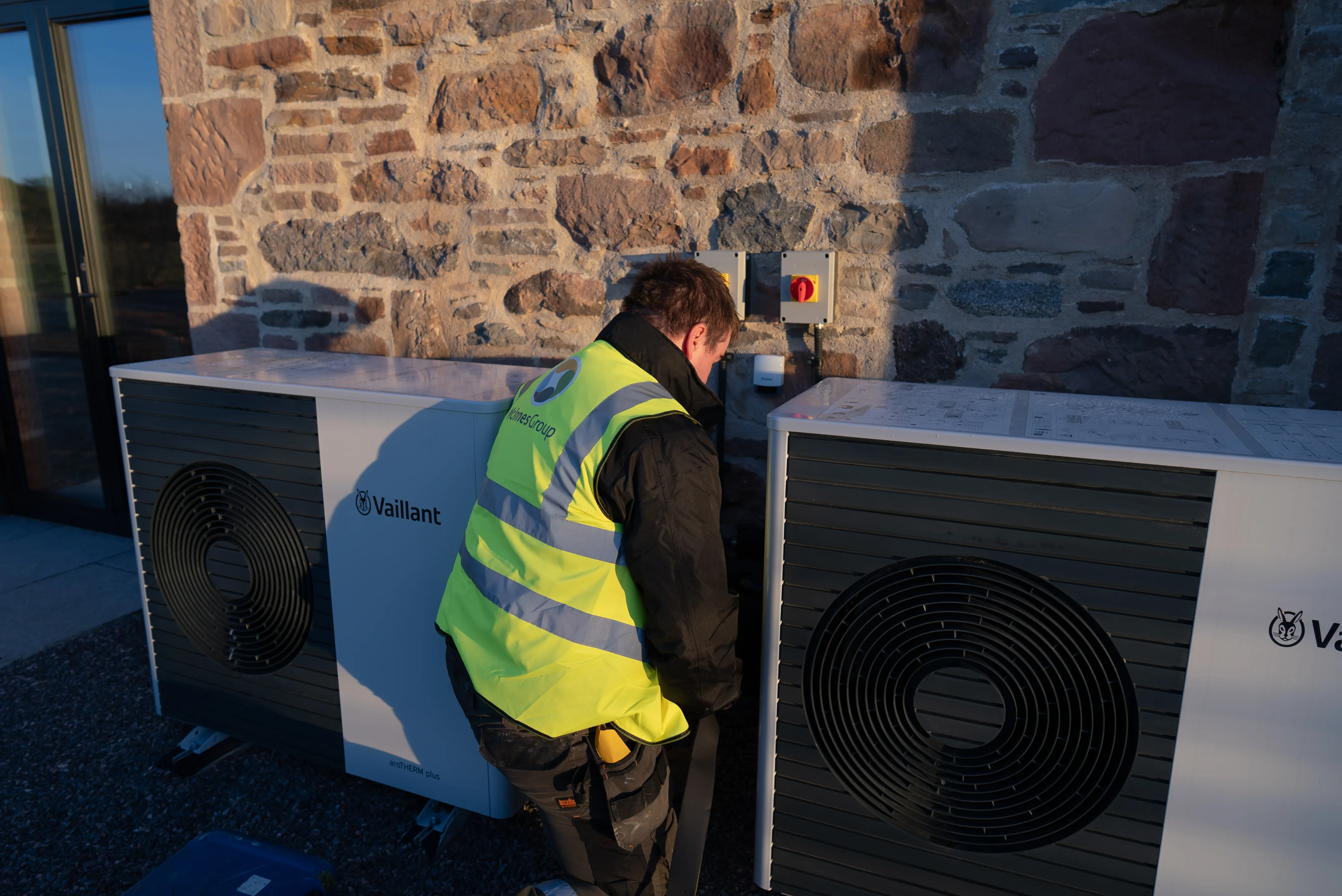
Air source heat pumps
Quiet, efficient heating designed for Scottish homes.
A heat pump replaces your gas or oil boiler with a low-carbon system that uses outside air to heat your home and hot water — three to four times more efficient than direct electric, and well-suited to Scottish conditions when designed properly.
Two minutes — the £7,500 grant you could claim and whether your home is a good fit.
How it works
Outside air, upgraded.
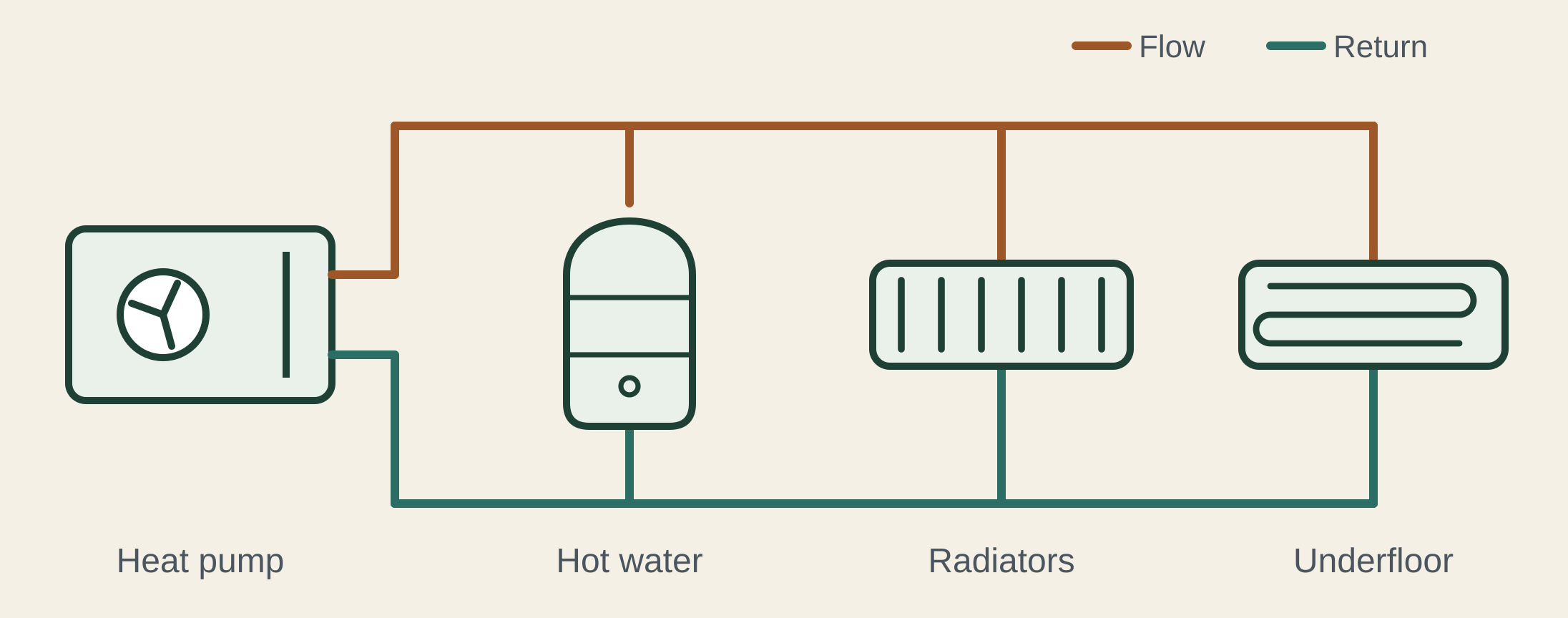
A heat pump extracts low-grade heat from the outside air and uses a refrigerant cycle to upgrade it to useful temperatures — typically 45–55°C — for your radiators and hot water cylinder. Even in sub-zero Scottish weather, the system still produces two and a half to three times the energy it consumes.
The outdoor unit sits at the side of the property; indoors, you get a cylinder roughly the size of a fridge. There is no flue, no fuel delivery, and no combustion. The whole system is controlled by a smart thermostat that learns your patterns and optimises for cost and comfort.
How we work
Six steps from estimate to a year of monitoring.
Heat pump installs run through the same six-stage process as every job we do — with a heat-loss-driven design as the centrepiece of the pre-start survey, and remote monitoring tuning the system through its first winter.
-
Step 1
Free estimate
A no-obligation estimate based on what you tell us about the property and what you want the system to do. No call-out fee, no pressure.
-
Step 2
Pre-start survey
Once an estimate is accepted, we carry out a proper site survey before any installation — measuring the building, modelling heat loss or generation, and checking the existing services.
-
Step 3
Full proposal
Issued after the survey. Clearly flags any changes from the estimate, with the reasoning. Fully transparent up front — no mid-job surprises.
-
Step 4
Installation
Carried out by fully qualified engineers at every stage. We programme the schedule with you and keep disruption to the building proportionate.
-
Step 5
Detailed handover
On every job. You leave the handover knowing exactly how the system works, what every control does, and where to find your paperwork.
-
Step 6
First-year monitoring & optimisation
We remotely monitor every system we install and optimise it through the first year — tuning for efficiency and comfort as you live with it through every season.
Why McInnes Group
The same team, start to finish.
- Surveyed, designed and project-managed in-house
- MCS-certified for Home Energy Scotland grant eligibility
- Specialist-trained on Vaillant and Mitsubishi systems
- Room-by-room heat-loss design — never a stock spec
- Locally based, locally responsive aftercare
- Remote monitoring through your first winter
Efficiency
Designed for SCOPs of 4.0+.
A well-designed air source heat pump delivers a SCOP (Seasonal Coefficient of Performance) of 4.0 or higher — meaning over 400% efficiency: for every unit of electricity it draws, it delivers four or more units of heat. We design for high seasonal performance, and our properly-specified systems routinely target SCOPs of 4.0+ even through Highland winters.
What SCOP means in plain English. SCOP averages a heat pump's performance across a whole heating season — the cold mornings and the milder afternoons, the shoulder months and the deep winter. A SCOP of 4.0 means the system delivered four kilowatt-hours of heat for every kilowatt-hour of electricity it used. A gas boiler, for comparison, runs at about 0.85 (85% efficiency). The number depends on the building, the flow temperatures we run at, and how we set the controls — which is why the design work matters as much as the kit.
Costs & grants
What it costs — and what the grants cover.
Priced from your survey
With the Home Energy Scotland grant applied
No two homes price the same, so we don't quote from a rate card. The figure depends on property size, the heat-loss survey, and how much of your existing system we can sensibly retain — then the Home Energy Scotland grant comes off the top. Your free estimate gives you a real number for your home, not a range that means nothing.
Home Energy Scotland grant
The Scottish Government's cashback grant for MCS-certified heat pump installs — up to £7,500, with an additional £1,500 rural uplift where the property qualifies. It's aimed at homes moving off fossil fuels, so an existing renewable system can affect eligibility. Home Energy Scotland decides eligibility and the amount — you apply to them directly yourself, and as an MCS-certified installer we provide the technical documents you need for your application.
Home Energy Scotland loan
Home Energy Scotland offers an interest-free loan towards the balance after the grant, arranged directly with them. And if you’d rather spread the cost, finance is available — just ask.
For Scottish businesses & community organisations
We work with Scottish businesses, charities, and community organisations.
A meaningful share of our work isn't domestic. Community halls, faith buildings, charities, and small businesses across Scotland come to us to scope, fund, and install the same kind of low-carbon systems we put into people's homes — and many of them qualify for support they didn't know existed.
Funding you might not realise you can access
Most commercial and community installs in Scotland are part-funded by Scottish Government schemes administered through Home Energy Scotland and Energy Saving Trust. We tell you honestly which routes fit, draft the technical sections the funder needs from us, and support you from eligibility check to drawdown — you submit and own the application.
- CARES — Community and Renewable Energy Scheme: capital grants for charities, community groups, halls, and faith buildings.
- SME Loan + Cashback — interest-free loans for Scottish small and medium businesses, with cashback grants of up to £30,000 on energy-efficient upgrades.
- Business Energy Scotland — free advice, on-site audits, and route-finding for any commercial energy project. Often the right place to start.
- Public Sector Energy Efficiency Loans — for councils, schools, NHS sites, and other public bodies undertaking decarbonisation work.
Smart system design saves money
On many commercial installs we can retain existing components — controls, distribution pipework, radiators, panels, or cabling — that other installers replace by default. Smart system design typically delivers significant savings versus replace-everything quotes, though every commercial project varies. Same philosophy as our domestic work: design for the building you have, not the catalogue.
Most organisations don't know they qualify
Eligibility is broader than people assume. If you run a hall, a charity, a small business, or a community project anywhere in Scotland, it's worth a conversation — even just to find out what's available before you commit to a direction.
Frequently asked
Heat pump questions, answered honestly.
Will it work in cold Scottish weather?
Yes. Modern air source heat pumps are designed to operate efficiently down to -20°C and below. They lose some efficiency in extreme cold but continue to produce useful heat. Across Scotland — including Highland winters where lows typically sit around -5 to -10°C — a properly sized heat pump performs reliably year-round. Every system we design is built around your specific heat loss data, not generic assumptions.
How noisy are they?
Modern outdoor units run at 35–45 dB measured at 1 metre — roughly the same as a fridge. Sound levels drop further with distance. We position the outdoor unit away from windows and bedrooms by default, and most modern units have a quiet-mode setting for overnight operation.
Will my radiators need replacing?
Sometimes. Heat pumps run at lower flow temperatures than gas boilers (typically 45–55°C versus 70°C), so radiators need to be sized to deliver enough heat at that lower temperature. We assess every radiator during the survey. Often we can keep most existing radiators and replace only one or two — the room-by-room heat loss calculation tells us exactly where.
How much will my electricity bill increase?
Your electricity bill will go up because the heat pump runs on electricity — but your overall energy spend should drop, especially if you are moving off oil or LPG. A well-sized system delivers around 3 kWh of heat per kWh of electricity used. Pair it with a smart tariff like Cosy Octopus and you can shift consumption to cheaper overnight windows.
What SCOP do your heat pumps achieve?
We design for a SCOP of 4.0+ — over 400% efficiency, so four or more units of heat for every unit of electricity. The exact figure depends on the building, the flow temperatures and the controls, which is why we design to your heat loss rather than a generic spec. (More on how we reach high seasonal performance in the efficiency section below.)
How long does an install take?
Typically 3 to 5 working days on site, with some preparation work beforehand. We replace the boiler, install the heat pump and cylinder, fit any radiator upgrades, and commission everything. We aim to keep at least intermittent hot water available throughout, and we agree the schedule with you before we arrive.
What happens if it breaks down?
Heat pumps come with manufacturer warranties of 5 to 7 years on the equipment. We provide a two-year workmanship guarantee on top — soon increasing to six years on MCS installations — and an annual service that keeps the warranty valid. If something fails outside business hours, you have our number directly — we do not farm callouts out to a national service network.
Do you install for businesses or just homes?
Both — a significant share of our heat pump work is for Scottish businesses, charities and community organisations. Most commercial installs are part-funded through Scottish Government schemes; our commercial and grants pages walk through what your organisation may qualify for.
Real customer review
A real install, in their own words.
“The house is always warm — plenty of hot water for the kids.”
Read the full Evanton case study.
Get in touch
Tell us about your project.
We'll be in touch within one working day. No call-out fee, no obligation.
Thanks
We'll be in touch within one working day.
If it's urgent, call us on 01463 231 423 — Monday–Friday, 08:00–17:00.
Prefer to talk? Call 01463 231 423 or email info@mcinnesgroup.co.uk.