
Ground source heat pumps
The right choice when air source isn't — and the wrong choice when it is.
Ground source is a smaller share of what we install than air source, and that's how it should be: for most properties, air source is the more cost-effective answer. But for larger rural homes, awkward sites, and bigger commercial loads, ground source is genuinely the better engineering. We design and install both, and tell you which fits.
Where it fits
Lower volume than air source. The right call for some properties.
Most heat pump installs we do are air source — it costs far less to install, gets the same grants, and performs well in Scotland when designed properly. Ground source earns its higher cost in specific cases: larger rural homes, properties with nowhere sensible for an outdoor unit, and bigger commercial loads. We design both, and we'll tell you honestly at survey which one fits.
How it works
Ground loops, upgraded indoors.
A ground source heat pump extracts heat from the soil or bedrock through buried pipework and uses a refrigerant cycle to upgrade it to useful temperatures for your radiators or underfloor heating and your hot water cylinder. Underground temperatures in Scotland sit at roughly 10–12°C year-round, so the system performs more consistently in winter than an air source unit, which has to extract heat from -5°C air on the coldest days.
There are two ways of putting the ground array in. Boreholes are vertical — typically 80–150 metres deep, drilled by a specialist rig — and need very little permanent land. Slinky or trench loops sit horizontally a metre or so below the surface and need a clear paddock or large lawn. We specify whichever fits your site and your budget at survey.
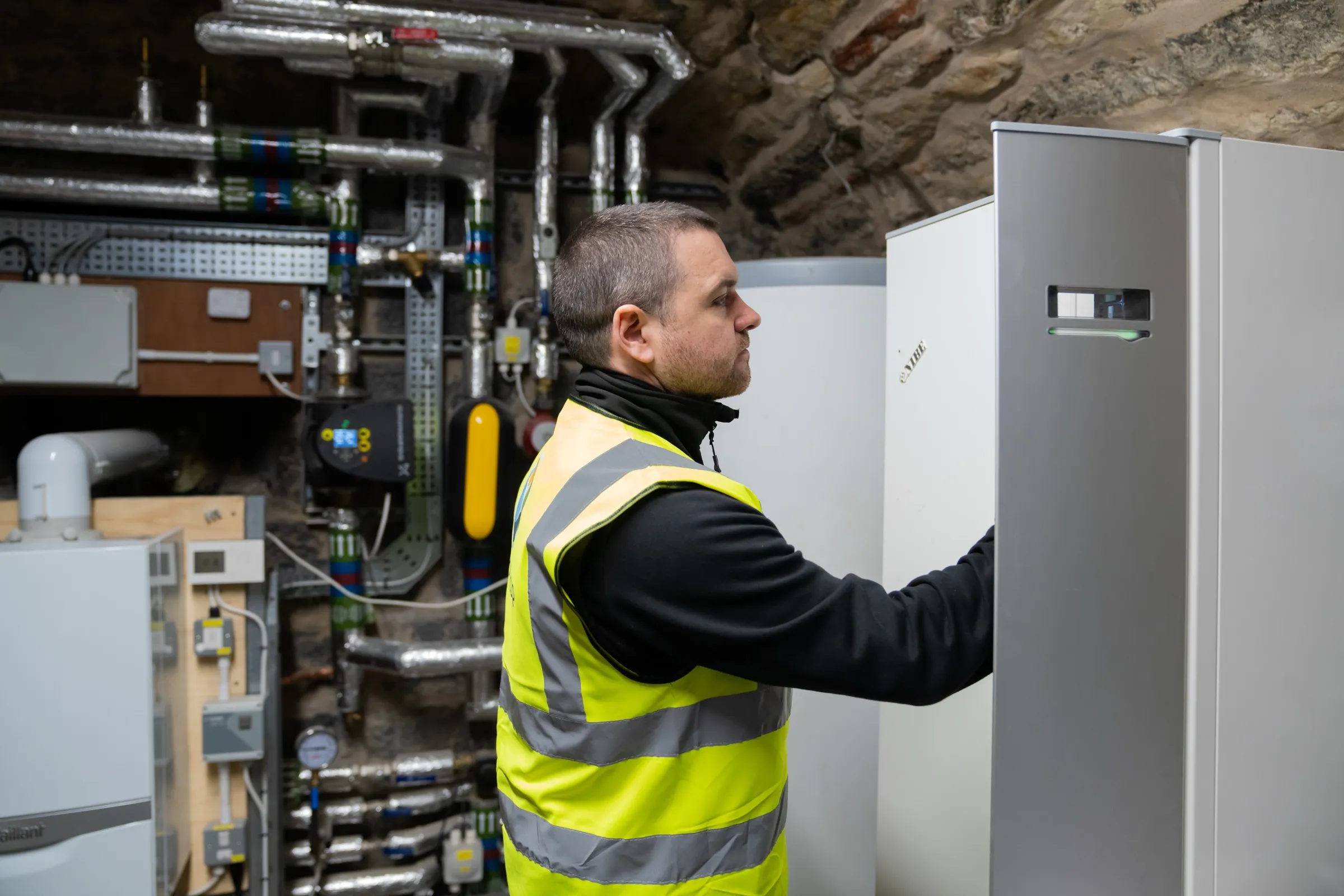
Indoors, the plant looks very similar to an air source install: a heat pump unit roughly the size of a tall fridge, a hot water cylinder, a manifold, and controls. No outdoor fan unit, no flue, no fuel delivery.
How we work
Six steps, with a specialist drilling partner.
Ground source installs run through the same six-stage process as every job we do. The ground works themselves — drilling boreholes or laying slinky trenches — are delivered alongside a trusted specialist drilling partner; we design, project-manage and commission the rest in-house.
-
Step 1
Free estimate
A no-obligation estimate based on what you tell us about the property and what you want the system to do. No call-out fee, no pressure.
-
Step 2
Pre-start survey
Once an estimate is accepted, we carry out a proper site survey before any installation — measuring the building, modelling heat loss or generation, and checking the existing services.
-
Step 3
Full proposal
Issued after the survey. Clearly flags any changes from the estimate, with the reasoning. Fully transparent up front — no mid-job surprises.
-
Step 4
Installation
Carried out by fully qualified engineers at every stage. We programme the schedule with you and keep disruption to the building proportionate.
-
Step 5
Detailed handover
On every job. You leave the handover knowing exactly how the system works, what every control does, and where to find your paperwork.
-
Step 6
First-year monitoring & optimisation
We remotely monitor every system we install and optimise it through the first year — tuning for efficiency and comfort as you live with it through every season.
Why consider it
When ground source genuinely earns the extra cost.
- Steadier efficiency — ground temperature holds up in deep winter
- No outdoor fan unit — ideal for listed and conservation sites
- Quieter — no compressor near windows or boundaries
- 50+ year lifespan on the buried ground loop
- Scales naturally to larger heat loads
- MCS-certified for Home Energy Scotland funding
Best suited to
The properties where it pays back.
- Larger rural homes (200m²+) where efficiency repays the upfront cost
- Listed buildings and tight sites with nowhere for an outdoor unit
- Sites with land — paddocks for trenches, or yard space for a borehole rig
- Community halls, hotels, schools and estates with big peak demand
- Owners staying long-term who want the lowest lifetime running cost
Costs & grants
What it costs — and what the grants cover.
Priced from your survey
Ground source is a bespoke installation — the array type, ground conditions and plant size drive the cost, so we price from the survey rather than a rate card. It is a significantly bigger investment than air source, offset by the Home Energy Scotland grant and decades of lower running costs.
Significantly higher than air source. Ground works (trenches or boreholes) are the main cost variable. The Home Energy Scotland grant applies on the same terms as for air source — see below.
Home Energy Scotland grant + loan
The Home Energy Scotland scheme covers ground source heat pumps on the same terms as air source — cashback grant of up to £7,500, plus an interest-free loan of up to £7,500 covering the balance, repayable over up to 12 years. You apply to Home Energy Scotland directly yourself; we provide the technical documents you need for your application.
Rural uplift
Properties in eligible rural areas attract an additional £1,500 on top of the Home Energy Scotland grant — a meaningful contribution given the higher upfront cost of a ground source install. Most rural Scottish properties qualify; we'll confirm at survey.
Frequently asked
Ground source questions, answered honestly.
What's the difference between ground source and air source?
Both extract low-grade heat and upgrade it with a refrigerant cycle. Air source takes heat from outside air; ground source takes it from soil or rock via underground pipework (a borehole array or buried slinky loops). Ground source has better year-round efficiency because ground temperatures don't swing the way air does — a UK borehole sits at roughly 10–12°C all year. The trade-off is upfront cost: ground source is significantly more expensive to install because of the ground works. For most modest UK homes, air source is the more cost-effective choice. Ground source comes into its own on larger properties and bigger commercial loads.
How much land do I need?
Two routes. Boreholes are vertical — typically 80–150 metres deep — and need a few metres² of clear access for the drilling rig but very little permanent surface area. Slinky or trench loops are horizontal, buried about 1–1.5 metres down, and need roughly 2–3 times your house footprint of clear land (no buildings, no large tree roots). For a 200m² home that means an area of around 400–600m². Most rural Scottish properties have one of those two routes available; many have both.
Do I need planning permission?
In most cases no — domestic ground source installations generally fall within Permitted Development in Scotland, as long as the array is below ground and the indoor plant is internal. There are exceptions: listed buildings, conservation areas, and some commercial sites can need consent. We'll flag any planning requirement at survey and, where needed, support the application or refer you to a planning consultant. The Home Energy Scotland grant is unaffected either way.
How long does the install take?
Plan for 2–4 weeks from first plant on site to commissioning, but spread across two phases. The ground works (drilling or trenching) typically take 1–2 weeks depending on the array size and access. The plant room install runs alongside or after that and takes 3–5 days. Most of the disruption is concentrated in the ground-works phase; the indoor work is no more invasive than a boiler swap.
What kind of property is ground source actually best for?
Large rural homes where the higher upfront cost is justified by decades of lower running costs, properties where an outdoor air source unit would be visually or acoustically intrusive (listed, conservation, tight courtyards), and larger commercial loads where the peak heat demand makes the borehole investment pay back faster. For most three-to-four-bedroom Scottish homes on standard plots, an air source heat pump is the more cost-effective answer — and we'll tell you so honestly during the survey.
Why don't more installers offer ground source?
Two reasons. First, the ground works require specialist plant and partners — drilling rigs, trenching equipment, and the engineering knowledge to specify the array correctly. Second, the volume is lower: most installs done in Scotland are air source, so a lot of installers focus there and either contract the rare ground source enquiry out wholesale, or turn it down. We design and project-manage the full install ourselves, working with a trusted drilling partner for boreholes — the same accountability line as our ASHP work, from first survey through to commissioning.
Pairs well with
Worth comparing — or combining.
Air source heat pumps
Most customers considering ground source end up with air source — it's almost always more cost-effective for typical UK homes. Worth comparing properly before you commit.
Read more →
Solar PV
A heat pump runs on electricity. Generating some of it on the roof shifts the long-term economics meaningfully — especially with ground source running year-round.
Read more →
Get in touch
Tell us about your project.
We'll be in touch within one working day. No call-out fee, no obligation.
Thanks
We'll be in touch within one working day.
If it's urgent, call us on 01463 231 423 — Monday–Friday, 08:00–17:00.
Prefer to talk? Call 01463 231 423 or email info@mcinnesgroup.co.uk.